
India–UK Trade Deal What It Means for Public Procurement & Supply Chain Rules
By: Dr Mohan Kaul, Ahana Raina
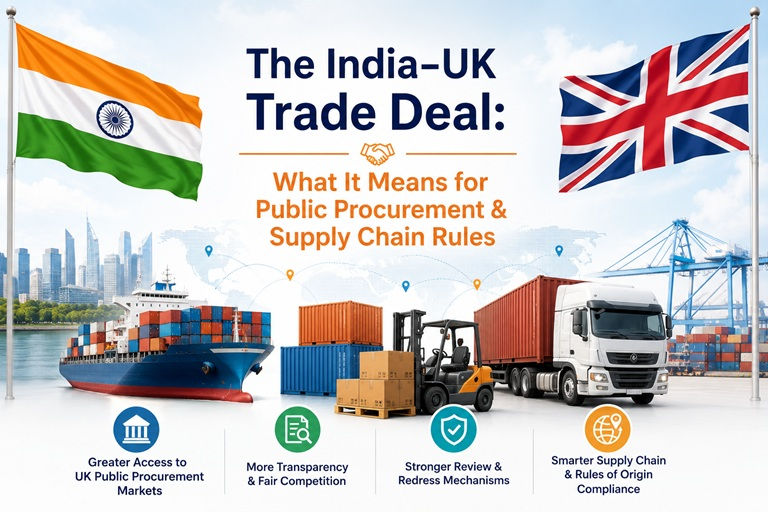
In earlier papers in this series, we examined how the India–UK Comprehensive Economic and Trade Agreement (CETA) reshapes tariff structures, expands services and digital trade, and creates new mobility pathways for professionals.
This final instalment focuses on an often overlooked but commercially decisive dimension: public procurement and supply chain rules.
For Indian businesses — whether headquartered in India, operating through UK subsidiaries, or embedded in global supply chains — this area determines not only market access, but long-term participation in government-led economic growth across infrastructure, healthcare, digital transformation, and green energy.
☀️ Why This Matters for Business Leaders
Public procurement in the UK is estimated to be worth over £300 billion annually across central and local government, the NHS, utilities, defence, education, and infrastructure programmes. This makes it one of the largest structured demand pools in the UK economy.
However, it is important to be precise:
Indian firms are not “excluded” today through discrimination, but rather face structural barriers such as:
• complex tendering systems
• incumbency advantages
• qualification thresholds
• regulatory familiarity gaps
• compliance and risk requirements
The India–UK agreement does not “open all procurement” — instead, it improves transparency, expands defined access under thresholds, and strengthens procedural fairness for eligible suppliers.
🌇 What the Agreement Actually Does
1. Market Access Under Defined Threshold
The procurement chapter introduces mutual commitments based on coverage schedules and financial thresholds, consistent with WTO-style Government Procurement Agreement (GPA) architecture.
Above these thresholds:
• Indian suppliers can compete in covered UK procurement markets on non-discriminatory terms
• UK suppliers receive reciprocal access in India’s covered procurement entities
However, it is critical to understand:
• Coverage is not universal
• It applies mainly to central government and specified entities
• Many sub-central bodies (local councils, devolved authorities, some NHS trusts) are only partially or selectively covered
This means businesses must map opportunities carefully rather than assume blanket access.
2. Transparency and Equal Treatment
A key strengthening effect of the agreement is procedural:
Covered procurement processes must provide:
• prior publication of tenders
• clear technical specifications and award criteria
• transparent evaluation processes
• defined timelines
• non-discriminatory treatment of suppliers
These provisions significantly reduce uncertainty for foreign bidders and improve predictability.
Importantly, this aligns with the UK’s domestic reform under the Procurement Act 2023, which modernises public procurement rules and strengthens transparency and supplier feedback mechanisms.
3. Review and Redress Mechanisms
One of the most commercially important elements for Indian businesses is access to challenge procedures.
Under UK procurement law (and reinforced by international commitments):
• suppliers can challenge procurement decisions
• courts can review unfair or non-compliant awards
• remedies may include suspension or compensation
This is not unique to India–UK trade — but the agreement ensures Indian suppliers are explicitly covered under these procedural guarantees within the scope of the agreement.
Supply Chain Rules: Where Real Commercial Value Is Determined
The most important operational constraint in the entire agreement is not tariffs or procurement access — it is rules of origin (RoO).
1. Rules of Origin (Critical for Eligibility)
To benefit from preferential tariffs or procurement-linked supply opportunities, goods must satisfy origin requirements:
• sufficient transformation in India or the UK
• minimum value addition thresholds
• product-specific processing rules
This has direct implications for export-heavy sectors such as:
• textiles and apparel
• pharmaceuticals
• automotive components
• chemicals
• electronics
For example: A garment manufacturer in India sourcing fabric from China may not qualify as “originating” under the agreement unless value addition thresholds are met.
Similarly, pharmaceutical products using third-country APIs may require detailed origin analysis to determine eligibility.
Key point: eligibility is product-specific and must be verified at HS-code level.
2. Cumulation (Important but Technical)
The agreement may include forms of cumulation, allowing inputs from specified partner countries to count toward origin.
If properly structured, this increases flexibility in:
• sourcing inputs
• maintaining cost competitiveness
• preserving preferential access
However, cumulation rules are highly technical and vary by product category. Businesses should not assume applicability without formal verification.
3. Compliance and ESG-Linked Supply Chain Requirements
A major trend shaping procurement access is not tariff-related — it is compliance-driven.
Indian exporters supplying UK public or private sector buyers increasingly face requirements under:
• the UK Modern Slavery Act 2015
• public procurement social value requirements
• ESG disclosure expectations
• supply chain transparency audits
This means UK buyers are increasingly assessing:
• labour standards
• environmental compliance
• traceability of inputs
• ethical sourcing practices
This is now a commercial competitiveness factor, not just a compliance obligation.
Firms that demonstrate strong ESG and traceability systems are more likely to win contracts.
Sectoral Opportunities for Indian Firms
1. IT and Digital Services
UK government digital transformation programmes create opportunities in:
• cloud infrastructure
• cybersecurity
• digital platforms
• AI and data services
Indian IT firms are already globally competitive in these areas.
2. Pharmaceuticals and Healthcare
India is a major supplier of generics globally.
Opportunities include:
• NHS supply chains
• medical devices procurement
• digital health systems
• diagnostics and biotech services
3. Infrastructure and Engineering
UK infrastructure spending supports:
• transport upgrades
• housing development
• urban regeneration
• energy infrastructure
Indian engineering firms can participate more directly in public procurement frameworks than historically possible.
4. Clean Energy and Green Transition
This is one of the most strategically aligned sectors:
• offshore wind supply chains (UK strength)
• solar manufacturing (India strength)
• grid infrastructure
• hydrogen and storage technologies
Public procurement will be a key channel for delivering net-zero investment commitments in both countries.
5. Defence and Aerospace
While sensitive and partially restricted, there is growing scope for:
• component manufacturing
• dual-use technologies
• MRO (maintenance, repair, overhaul) services
• R&D collaboration
This is supported by broader strategic cooperation frameworks beyond the trade agreement itself.
What Businesses Should Do Now
1. Map Rules of Origin Exposure
Conduct HS-code level analysis of export products to confirm eligibility for preferential treatment.
2. Identify Covered Procurement Markets
Do not assume full access. Instead:
• map which UK contracting authorities are covered
• identify threshold eligibility
• prioritise central government opportunities first
3. Build Procurement Capability
Winning public contracts requires capability beyond product competitiveness:
• bid writing expertise
• compliance systems
• procurement intelligence
• framework contract participation
4. Strengthen ESG and Compliance Systems
UK procurement is increasingly driven by:
• sustainability criteria
• labour compliance
• governance transparency
This will only intensify over time.
5. Leverage Diaspora Networks
The UK–Indian business diaspora is one of the strongest informal commercial networks in the world.
It supports:
• market entry intelligence
• partnership formation
• subcontracting opportunities
• institutional navigation
The Bigger Picture
Public procurement is often underestimated in trade agreements, but it is one of the most durable forms of economic integration.
Unlike tariff changes, procurement access:
• creates long-term institutional relationships
• embeds firms into government supply chains
• generates recurring revenue streams
• builds reputational credibility in foreign markets
For India and the UK, this agreement represents a gradual but meaningful shift toward rules-based, transparent, and competitive cross-border procurement systems.
Conclusion
The India–UK trade agreement does not simply open markets — it reshapes the architecture of participation in public spending and supply chains.
For Indian businesses, the opportunity is significant but conditional:
• access exists, but must be earned through compliance
• opportunity exists, but requires capability building
• markets are open, but structured by rules, thresholds, and standards
Those who invest early in understanding procurement systems, rules of origin, ESG compliance, and bid readiness will be best positioned to convert legal access into commercial success.
Public procurement rarely makes headlines. But in many cases, it is where the most stable and scalable business opportunities in international trade actually reside.


Comments